


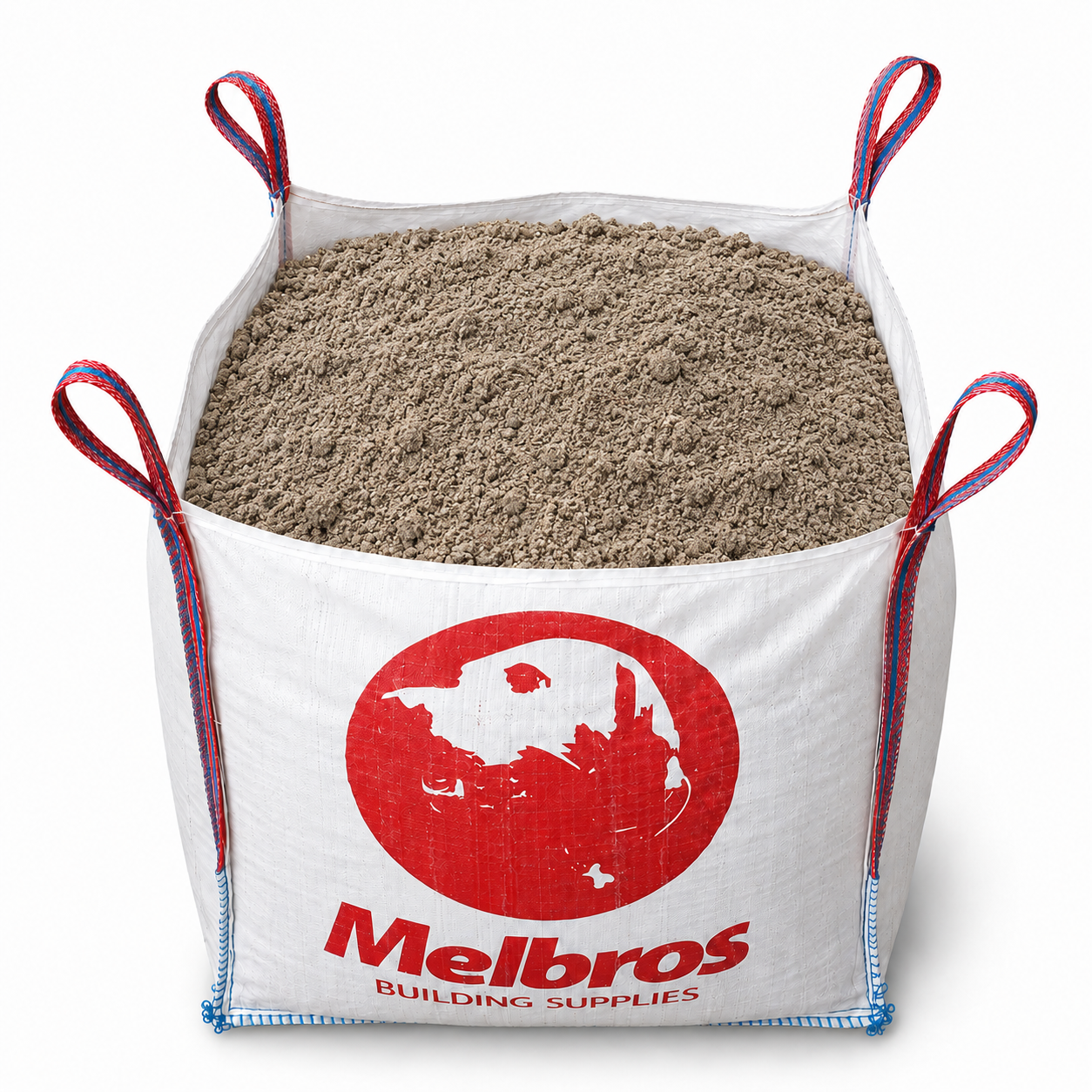

Sharp Concreting Sand Bulk Bag
Sharp (grit) sand is primarily used for concreting applications and can be used as a bedding for slabs and block paving.
Available in: Bulk Bags (approx 1 tonne), Half Bulk Bags (approx 1/2 tonne), Bulk Loose (from 1/2 tonne, on enquiry), Poly Bags (approx 25kg)
Delivery options available in the Rugby area
As an approximate guide, one bulk bag will cover:
• 18–20m² at a depth of 25mm
• 9–10m² at a depth of 50mm
• 4.5–5m² at a depth of 100mm
Paving laying courses and block paving sub-bases commonly require around 25mm to 50mm of sharp sand, while pipe bedding or deep levelling layers may require 75mm or more depending on the project requirements.
These figures are estimates only. Actual coverage will vary according to the bag weight, moisture content, compaction and the accuracy of the excavation.
Not sure how many bags you require? Call our Rugby team on 01788 866945 with the length, width and required depth.
Sharp sand is intended as a screeding, bedding, or concrete mixing material rather than a decorative finished surface. Colour and grain texture can vary according to the source of the sand.
You can use our online calculator at https://www.melbros.com/calculator
Excavate the area to the required depth and prepare the ground appropriately. A suitable geotextile membrane may be required where the subgrade is soft, unstable, or likely to mix with the sharp sand layer.
Spread the sharp sand evenly over the prepared sub-base to create a level laying bed, typically to a depth of 25mm to 50mm. Compact and screed the sand using a straight edge to form a smooth, flat surface prior to laying pavers or slab units.
Check the finished level and fall to ensure proper drainage before installing paving, block paving, or another surface. Avoid walking on or disturbing the screeded sand layer before the finished surface is laid.
Requirements vary according to ground conditions, loading, and the type of finished surface. Follow the project specification or seek professional advice where appropriate.
Available for collection from our Rugby branch or local delivery using our own fleet.
Bulk bags will normally be delivered by a crane-equipped lorry. Delivery is kerbside and the final offloading position is always subject to safe access and the driver’s discretion.
Please tell us before delivery about:
• Narrow roads or restricted entrances
• Parked vehicles or limited turning space
• Overhead cables, trees or other obstructions
• Soft, sloping or unsuitable ground
• Any other access concernsEnter your postcode on the product page to check your delivery area. We’ll confirm the delivery date after your order is placed.
What is the difference between sharp sand and building sand?
Sharp sand has larger, sharper grains with a low clay content, making it firm and highly permeable. Building sand features smaller, rounded grains that produce a smooth, sticky mortar ideal for bricklaying and pointing.
Is sharp sand suitable for garden soils?
Yes. Sharp sand is commonly mixed into heavy clay soils to break up dense earth, improve soil aeration, and enhance drainage for plants and lawn turf.
Can sharp sand be used for mixing concrete?
Yes. When combined with cement, coarse aggregate (such as gravel or crushed stone), and water, sharp sand produces strong concrete suitable for footings, posts, and bases.
Does the color of sharp sand matter?
No. The color of sharp sand—ranging from light grey to reddish-brown—depends on the quarry source and natural mineral content. Color variation does not affect its performance or structural properties.
Is sharp sand safe for children's sandpits?
No. Due to its larger, angular grain size, sharp sand can be abrasive on sensitive skin. Soft, washed play sand should always be used for sandpits instead.


